
Impact Review · Products
Products Changed for Good
We are redesigning how apparel products are created — scaling circular materials, advancing responsible sourcing, and embedding innovation across our design-to-delivery model to help brand partners transition toward next-generation product ecosystems.
Sustainable products
Sustainability, realised through what we make
Our sustainable product strategy embeds sustainability at the heart of product creation. We are guided by a clear definition of sustainable products — those that are good for the wearer, good for the planet, and good for business — and have linked progress in sustainable products directly to business performance.
As a manufacturer, MAS operates at the intersection of brands and supply chains. This position enables us to translate emerging technologies and material innovations into scalable product solutions, bridging the gap between innovation and commercial application — particularly in circularity, where alignment between multiple stakeholders is required to move from concept to scale.

Our product strategy
Three pillars guiding how we create sustainable products
Operating at the intersection of brands and supply chains, our sustainable product strategy rests on three reinforcing commitments.
Innovate & Disrupt
Translate emerging technologies and material innovations into scalable product solutions.
Source Sustainably
Advance responsible, transparent sourcing across a complex multi-country supply network.
Pioneer Circularity at Scale
Close the loop on post-consumer and post-industrial textile waste.
A clear definition
What makes a product sustainable
A sustainable product is one that is good for the wearer, good for the planet, and good for business.
Assessment criteria
- Raw Materials
- Design & Merchandising
- Manufacturing Processes
- Circularity
- Social Impact
Contribution to sustainability impact
Raw materials dominate the product footprint, making material choices the single largest lever for change.
- Raw Materials86%
- Manufacturing Processes8%
- Social Impact5%
- Design & Merchandising1%
Input material mix
Renewable and recycled inputs now account for nearly half of our material profile, with further gains targeted to 2030.
- Non-renewable51%
- Renewable34%
- Recycled15%
Revenue from sustainable products
Climbing from 28% to 46% in four years
Progress in sustainable products is linked directly to business performance. The 2030 ambition raises the bar to 75% of revenue.
“Sustainable products contributed 46% of revenue in 2025, continuing a steady increase from 28% in 2022.”
Innovate & Disrupt
Innovations changing how products are made
We translate emerging technologies and material breakthroughs into scalable product solutions — spanning circular fibres, water-free finishing and next-generation wearables.
HeiQ AeoniQ™
HeiQ, Switzerland · 2023
A next-generation cellulosic yarn that replicates the performance of polyester and nylon from renewable feedstock. In 2025 it was integrated into a real-world marathon wearer trial and customer development pipelines.
Ambercycle Cycora®
Ambercycle, USA · 2024
Regenerated polyester made from end-of-life textile waste using molecular regeneration, enabling textile-to-textile recycling. Applied within a customer-led collection in 2025, laying groundwork for nylon circularity.
PERCVD
Plasma coating technology
A proprietary, water-free plasma coating — among the first in apparel — that restores water-repellency and stain resistance using non-fluorinated chemistries, eliminating 'forever chemicals' and extending product life.
Promptly
On-demand manufacturing
A demand-driven model using precision digital printing and real-time data to produce garments only when required — eliminating excess inventory and improving water and energy efficiency.
Femography
Absorbent technology
A textile-based innovation for menstrual health and incontinence, offering a reusable, ultra-thin alternative to disposables — protecting the planet and empowering women.
Wavetec
Health-tech wearables
Clinically validated, regulatory-compliant active-compression systems that support circulation, manage fluid build-up and enhance recovery — improving patient comfort, accessibility and treatment adherence.
GamerTech
Passive compression · esports
Wearable performance solutions for emerging segments such as esports. Passive compression provides targeted support to improve circulation, reduce fatigue and enhance endurance for lifestyle and performance applications.
Regulatory landscape
Designing for a tightening policy environment
A wave of product and material regulation is reshaping the industry. We track and prepare for these frameworks to keep our brand partners ahead of compliance.
PEF
Product Environmental Footprint — LCA-based validation of next-gen vs conventional materials.
ESPR
Ecodesign for Sustainable Products — circularity, durability and resource efficiency by design.
DPP
Digital Product Passports — traceability and product-level data systems.
EU Textile & Waste
Textile-to-textile recycling and design for recyclability.
REACH
Safer chemical inputs and stricter material safety.
Green Claims
Substantiated, verifiable, LCA-backed sustainability claims.
Source Sustainably
Responsible sourcing across a complex network
Raw materials represent roughly 60% of total product cost. Operating across seven countries, MAS navigated cotton price volatility, tariff shifts and pricing pressure while deepening ESG integration across the supply base.
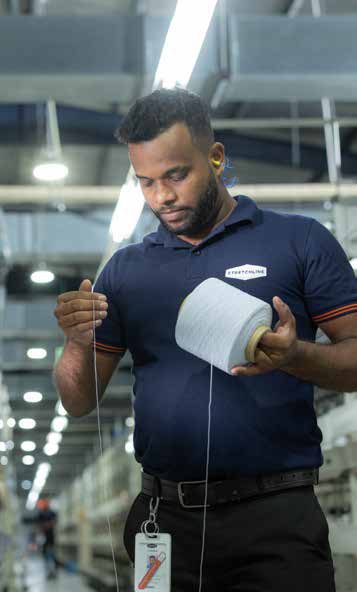
Areas of focus
- Managing cost & network complexity
- Strengthening supply-chain capabilities
- Advancing sustainability & transparency
2025 highlights
- Established fabric production in Egypt to strengthen regional supply resilience.
- Onboarded Noyon Lanka as a bluesign®-certified partner.
- 100% of new supplier spend covered by mandatory ESG onboarding.
Supply-chain ESG coverage
Pioneer Circularity at Scale
Closing the loop on textile waste
2025 was a foundation-building and validation phase for circularity. Cycora® was validated across customer-led programmes, with exploratory work to extend textile-to-textile regeneration beyond polyester.
Where we are focusing
- Exploring circular material pathways
- Building capability across product functions
- Enabling scale through partnerships
Challenges to scale
- Developing collection & recycling infrastructure
- Complexity sorting textile waste
- Limited quality feedstock
- Cost & scalability constraints
2030 ambition
75% of revenue from sustainable products by 2030.